
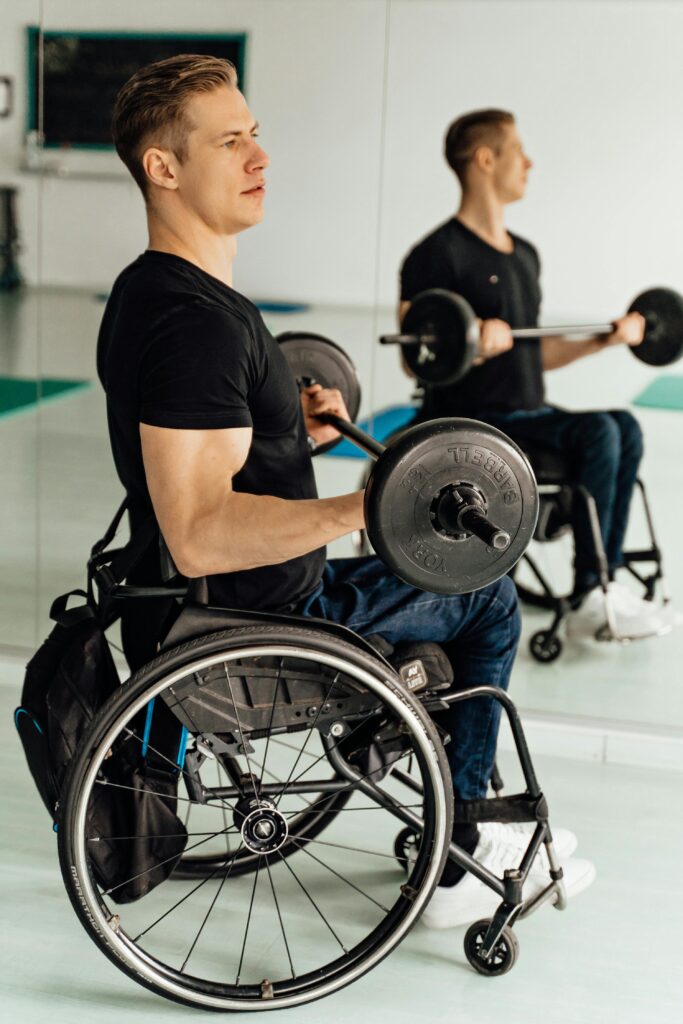
Whether you’re weeks or years out from your spinal cord injury, rehabilitation is complicated and requires a skilled physical therapist. In the acute phase, you’re working to maximize functional return. In the chronic phase, you may have new goals or concerns.
From protecting your shoulder health to getting fitted for a new wheelchair, having a spinal cord injury requires constant problem solving. At Cortex Rehab in Bozeman, every session is one hour, one-on-one, with a physical therapist who has experience treating those with spinal cord injuries
WHO IS THIS FOR?

Weeks to years post-spinal cord injury and wanting to maximize recovery
Struggling with transfers, wheelchair mobility, and navigating your home and community
Wanting to protect your shoulders and stay strong for daily life
Needing evaluations or fittings for braces or wheelchairs
Finished with insurance-covered therapy but NOT done recovering
WHAT YOUR FIRST VISIT LOOKS LIKE
Your first visit is a full hour, one-on-one with Nichole.
1
We talk through your diagnosis, symptoms, and goals.
2
We assess your strength, range of motion, spasticity, coordination, and sensation.
3
We measure your walking and/or wheelchair mobility, seated and/or standing balance, and function, so we can track your progress over time.
4
You leave with a treatment plan, a home program, and clear next steps.
RECLAIM. RETRAIN. RECOVER
HOW WE APPROACH SCI RECOVERY
01
Get stronger.
People with spinal cord injuries are not fragile, which is why we promote high-quality strength training in our gym-based clinic.
02
Train at the intensity recovery requires
High-intensity training is still appropriate after spinal cord injury. We build it into your plan to target strength, endurance, and function.
03
Get the right fit
We evaluate, fit, and assist in ordering wheelchairs and lower extremity braces, including AFOs. We work with your preferred vendor so your equipment supports your goals and your body.
04
Keep your body flexible.
Flexibility supports breathing, mobility, and digestion, and helps reduce the risk of contractures and pressure sores.
05
Keep going between visits.
You’ll leave with a home program you understand and own.
06
Move through your world with confidence.
Stroke recovery responds to We train the situations that matter to you, like transfers, getting around your home, and navigating your community.
MEET YOUR THERAPIST
Nichole Andriolo, PT, DPT, CSRS, trained in spinal cord injury rehab at Saint Luke’s Rehabilitation Institute in Spokane, Washington, which was critical in developing her skills to treat patients with SCI. She also volunteers with Empower Spinal Cord Injury in Missoula, MT, connecting with clients and clinicians passionate about recreation and high-quality therapy for this population.

SPINAL CORD INJURY FAQ
How soon after a spinal cord injury can I start neuro PT?
As soon as you can! The first year post-SCI is when our nervous system is wired for recovery – but we know neuroplasticity can occur even decades after one’s injury.
What equipment do you have to support spinal cord injury recovery?
Cortex Rehab is equipped with a standing frame, Active Hands grip support, neuromuscular electrical stimulation, and an overhead harness system for balance and gait training. We also frequently trial equipment like the ARC-EX spinal cord stimulator. Equipment in our shared gym can also be adapted to each client’s needs.
Do you take insurance or Medicare?
We’re in-network with Medicare. We’re out-of-network with all other insurance plans and operate as a cash-pay practice to maintain our high standard of care. We can provide a receipt (superbill) you can submit to your insurance for possible out-of-network reimbursement. See our full FAQ for details.
I still want to see my current PT, can I also see you for extra treatment sessions or to help me get fit for a new wheelchair?
Absolutely. I’m happy to collaborate with your current therapy team so we’re all working toward your goals and you get the extra support you need. For wheelchairs, I can evaluate your needs, help with fitting, and work with you and your preferred vendor to make sure the chair is the right match for your body and your life..
What makes neuro PT different from regular PT?
Orthopedic physical therapy specializes in treating musculoskeletal conditions, but it doesn’t necessarily include the components needed to drive neuroplasticity. That’s why finding a physical therapist who specializes in neurological conditions is so important for your recovery.
READY TO GET STARTED?
Call 406-763-7779 or send us a message, and we’ll help you figure out the next step.
★★★★★
Nichole knows her profession and is eager to help with finding solutions and coming up with plans that accommodate change. Transverse myelitis is a very complex and unusual disease. She is willing to work hard and put her expertise to the test.
Clinton L.