

When patients come to my clinic after a stroke or spinal cord injury, their goal is almost always the same:
To walk.
Sometimes they want to walk better. Sometimes faster. Sometimes they just want to be able to walk at all.
Helping them reach that goal? That’s my job—and I love it. But where do we begin?
With an evaluation, of course.
So there we are: a patient and a physical therapist, united by one goal—getting that patient walking again. And we start from the ground up. Literally.
The first thing patients usually want to talk about is strength.
How strong one leg is. How weak the other feels. How much their arms can help.
And yes—this matters.
There’s no walking without strength. Muscles are the driving force behind every step.
But strength isn’t the whole story.
Don’t worry—I’m not here to dismiss strength. In fact, the entire mission of Cortex Rehab is helping people with neurological conditions get stronger.
But strength is only useful if you can access it.
Let me explain.
A patient recently came in with a two-year history of transverse myelitis. His top priority?
To perform stand-pivot transfers to and from his wheelchair.
He proudly described the strength training he’d been working on—and it was clear in his progress. Motivated and determined, he had already come a long way. Then, with excitement, he explained how he’d been practicing standing with his other physical therapist and was eager to show me.
I was all in. He had the strength to stand.
So we got him set up with his walker. And with a LOT of effort, he got to “standing.”
But something wasn’t right.
His feet weren’t flat on the ground (even with AFOs). His knees were bent. His trunk was hunched forward. If I let go, he’d fall.
What happened?
Here’s what I hadn’t mentioned yet: before we tried standing, I checked one more thing—his range of motion.
I’ll skip the measurements and give you the highlights:
His calves, hamstrings, and hip flexors were extremely tight.
Without addressing those limitations, standing transfers would remain a major challenge.
When your body hits the end of its available range during a movement, it will compensate however it can to get the job done.
That’s not always safe—or effective.
So how do we prevent range of motion from becoming the limiting factor?
Stretching and positioning.
Here are the top two muscle groups I find most patients need to pay more attention to:
1. Calves / Plantarflexors
Function: Help you do a heel raise in standing or point your toes when sitting or lying down.
Signs of tightness:
- You can’t sit with your feet flat and tucked underneath you.
- Your knee hyperextends or your ankle rolls during walking or standing.
- During transfers, your feet stay out in front instead of underneath you.
What helps:
- Keeping your feet tucked underneath you when sitting.
- Stretching regularly (see some of my favorites below)
- Use properly fitting night splints and/or AFOs.
- Manage spasticity with guidance from your physician or therapist.

For those that can stand independently, these stretches are a great option to target both calf muscles. When you bend the back leg while keeping your heel on the ground, you are stretching your soleus. When you keep the back leg straight, you are stretching your gastrocnemius.
Photo source:

For those who are unable to stand independently, this seated calf stretch with a towel can be a good tool to maintain your flexibility in your calf.
Photo source:

Finally, if you are unable to do the seated stretch above and have a caregiver or partner available to help, here is a video of a passive calf stretch.
2. Hip Flexors
Function: Lift your knee upward—like when climbing stairs or stepping forward.
Signs of tightness:
- Your thigh doesn’t rest flat when lying on your back.
- You struggle to stand upright or feel tightness across the front of your hip.
- You take short steps when walking.
What helps:
- If you use a wheelchair or sit often, laying flat on your back or stomach for a few minutes daily—especially if you’re a side sleeper.
- Stretch regularly (See some of my favorites below).
- Manage spasticity with guidance from your physician or therapist.

The key in this, and all, hip flexor stretches, is to keep your core engaged. Think about pulling your belly button to your spine.
Photo source: https://www.hingehealth.com/resources/articles/kneeling-hip-flexor-stretch/

If kneeling on the ground is too challenging, this stretch can be done on the edge of your bed. The video below does a good job with step-by-step instructions.
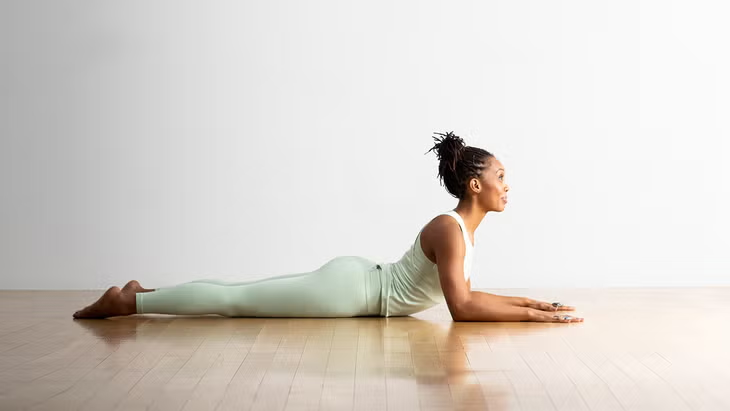
Like I said previously, even spending some time on your belly can be a great way to maintain flexibility in your hip flexors. To increase the stretch, position yourself on your elbows.
Photo source: https://www.yogajournal.com/practice/beginners/bhujangasana/
The takeaway?
Patients who maintain flexibility in these key muscle groups often find transfers, standing, and walking easier—even when strength is limited.
So yes, strength matters. But don’t ignore your range of motion.
It’s the foundation that lets strength do its job.
Wondering if your range of motion is holding you back?
If you’ve been working hard on strength but still feel stuck with walking, standing, or transfers, it might be time to take a closer look at your flexibility and joint mobility.
Whether you’re navigating recovery from stroke, spinal cord injury, or another neurological condition, I’m here to help you uncover what might be missing—and how to move forward.
📍 Reach out to Cortex Rehab if you have questions, concerns, or just want to make sure your mobility work is truly working for you. Let’s build a plan that gets you moving with confidence
Disclaimer:
This blog is intended for educational and informational purposes only. It does not substitute for medical advice, diagnosis, or treatment, nor does it replace a formal evaluation by a licensed physical therapist. If you have concerns about your mobility, range of motion, or rehabilitation needs, please consult a qualified healthcare provider.